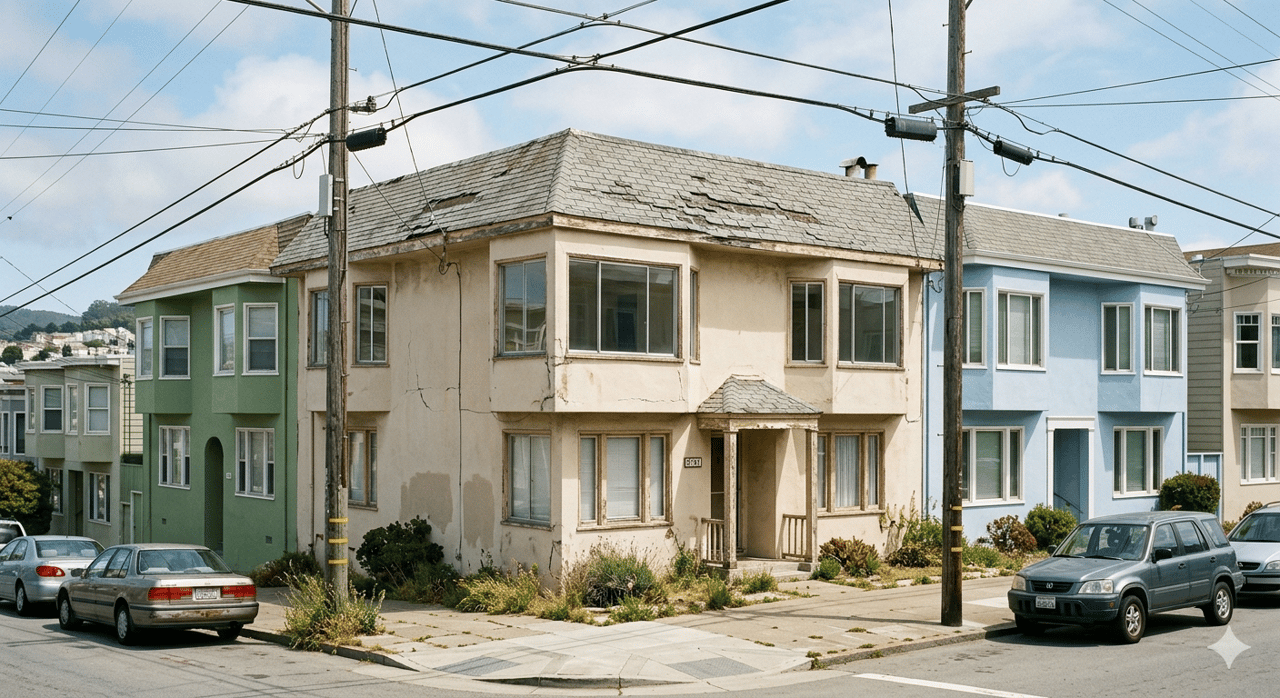
The Invisible Forced Sale: How the California Insurance Crisis is Hitting SF Homeowners
Retirement & Downsizing Karen McCarthy June 10, 2026
Retirement & Downsizing Karen McCarthy June 10, 2026
You likely know all about property taxes and capital gains when it comes to selling a longtime family home or managing a San Francisco trust administration. But there is a silent, devastating financial pressure creeping into local neighborhoods that most people do not see coming until they receive a notice in the mail.
Homeowners insurance.
The California insurance market is experiencing an unprecedented squeeze. Major carriers are pulling out of the state entirely, tightening underwriting guidelines, or issuing sweeping non-renewals. In San Francisco's historic neighborhoods, this is no longer just a hurdle for buyers trying to get a mortgage. It has turned into a major crisis for people who already own their homes.
For many longtime San Francisco homeowners and estate executors, this is not just a deal killer during escrow. It is a can't-afford-to-keep-my-home killer.
Insurance carriers are no longer just raising annual premiums. They are using strict drive-by inspections and aerial drones to issue mandatory repair ultimatums. If your property features forty years of deferred maintenance, a roof past its prime, or historic utility systems, carriers will issue an immediate notice: upgrade the property within 30 days or face total cancellation.
For an empty-nester living on a fixed income, or a family trust with limited liquid cash, a sudden demand to spend $25,000 on a new roof or $35,000 to replace original galvanized plumbing is financially impossible. If you cannot afford the upfront capital to make the repairs, your traditional coverage is dropped. This forces you onto the astronomical costs of the state's backup plan, draining your remaining cash flow and leaving many families with only one realistic option: selling the home.
This same capital trap crushes the dream of keeping a parent's home as a rental property. A major shock hits families who inherit a home and decide to rent it out for passive income instead of selling.
The moment a property transitions from an owner-occupied primary residence to a tenant-occupied rental, your insurance carrier requires you to rewrite the coverage into a landlord policy. Because you are no longer living on-site to spot a maintenance issue early, underwriters view rentals as significantly higher risk.
In the current market, transitioning to a landlord policy causes your annual premium to spike by 50% to 100%. When you combine this added cost with a Prop 19 tax reassessment and San Francisco's rent control laws, the math collapses. Heirs quickly realize they cannot afford the capital to update the old systems, but they cannot afford the carrying costs to keep the property without updating them. The insurance crisis actively forces a sale.
San Francisco is famous for its Edwardian and Victorian architecture. To a modern insurance underwriter, those same properties look like an expensive claim waiting to happen. If a longtime family home features any of the following, traditional insurance companies may deny or cancel coverage outright:
If you are trying to sell and a buyer cannot secure traditional insurance during escrow, their lender will deny their mortgage. Your transaction can collapse completely, forcing you back onto the market with a bruised listing history. This is entirely preventable with the right preparation.
When traditional insurance companies reject a property, the only remaining option is the California FAIR Plan. The FAIR Plan is a state-mandated pool that provides basic fire insurance coverage when no private company will insure a property. While it prevents deals from dying completely, it comes with significant costs and limitations.
You do not have to let an unpredictable insurance market derail your retirement timeline, your estate planning, or your home sale. Early preparation is the solution.
When I prepare a historic or longtime family home for the San Francisco market, I take a defensive approach before the property ever hits the MLS.
If you have recently inherited a San Francisco property, one of the first things to verify is whether the existing homeowners policy is still active and whether it covers you as the new owner. Policies often lapse or change at the time of death, and heirs frequently do not realize the property is uninsured or underinsured until something goes wrong.
Read my overview guide on what to do when you inherit a San Francisco home for the full picture of what to address first.
The California insurance market has fundamentally changed. What used to be a routine step in a real estate transaction is now a strategic decision that affects your timeline, your carrying costs, and your bottom line. Understanding it before you receive an ultimatum from your carrier is the difference between preserving your equity and facing a stressful financial emergency.
If you have questions about your specific property or situation, start with a conversation. No pressure, no obligation, just clarity. Let's Talk.
This article is for informational purposes only and does not constitute legal, tax, or insurance underwriting advice. Please consult a licensed insurance broker and qualified advisors for guidance specific to your situation.
Stay up to date on the latest real estate trends.

SF Estate & Probate Sales
Two Real San Francisco Estate Sales. Over $500,000 in Additional Proceeds. Here is How We Did It.
Retirement & Downsizing
When a "fix-it-or-get-cancelled" notice from your insurer turns into a retirement or estate planning emergency.

Retirement & Downsizing
The legal exemptions every SF empty-nester must understand before they sell.

Retirement & Downsizing
How San Francisco homeowners can take their low property tax rate anywhere in California.

SF Estate & Probate Sales
Property taxes, disagreements, and what happens when siblings cannot agree on what to do with the family home.

SF Estate & Probate Sales
How Proposition 19 treats single-family homes and multi-unit buildings very differently, and what it means for your family.

SF Estate & Probate Sales
A clear, stress-free guide for families figuring out what to do next.
No pressure. No obligation. Just an honest conversation about where you are and what makes sense for you.